
Switzerland’s 2026 single-price imbalance settlement: what it means for flexibility.
How Switzerland’s one-price model changes the economics of imbalance – and where flexible portfolios can create value.
Orvio Research
By Orvio
Published by Orvio Energy Intelligence AG
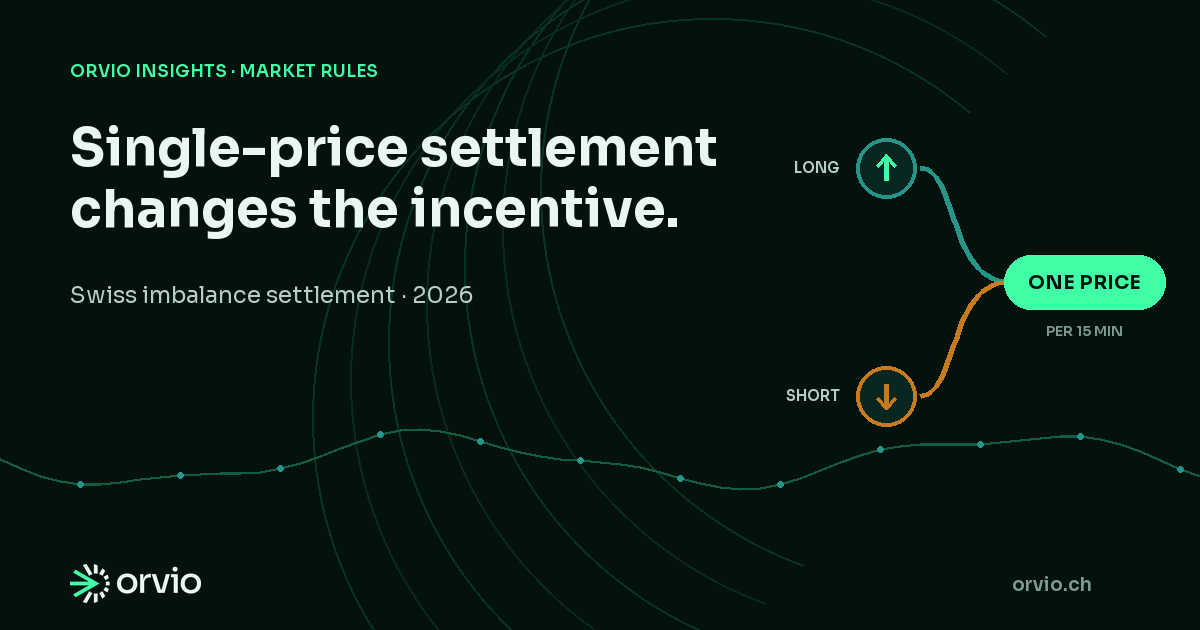
On 1 January 2026, Switzerland introduced a single-price mechanism for imbalance energy. Swissgrid’s stated aim was to reduce the need for control energy and strengthen the balance of the Swiss control area by giving balance groups and sub-balance groups a financial reason to consider the system as well as their own portfolios.[1][2]
That creates a new commercial question for flexible portfolios: can the position of a battery, hydro plant or flexible load support the direction the Swiss system needs, within the portfolio’s operational and contractual limits? The answer depends on three things at once – the control-area direction, the portfolio’s signed deviation and the imbalance price.
What changed on 1 January 2026
Before 2026, the asymmetric two-price mechanism primarily encouraged balance groups to close their own positions. The single-price model changed the settlement logic: for each 15-minute period, one imbalance price applies to both long and short balance-group deviations. The direction of the Swiss control area determines which price formula is used.[1][2][3]
The launch rules appeared in Appendix 1, V3.1, effective 1 January 2026. The mechanism was checked for this article against the current Appendix 1, V3.2, effective 1 April 2026. Swissgrid states that only its German documents are legally binding; the English versions linked here are translations provided for readability.[2][3][4][6]
One price, three signs to read
Swissgrid defines a positive total system imbalance as a long control area: generation exceeds consumption. A negative total system imbalance means the control area is short: generation is below consumption. A long portfolio deviation adds energy relative to schedule; a short portfolio deviation takes energy relative to schedule. Whether the portfolio supports the system depends on how those two directions combine.[8][3]
- When the control area is short, a long portfolio deviation is system-supportive; a short deviation amplifies the shortage.[8][3]
- When the control area is long, a short portfolio deviation is system-supportive; a long deviation amplifies the surplus.[8][3]
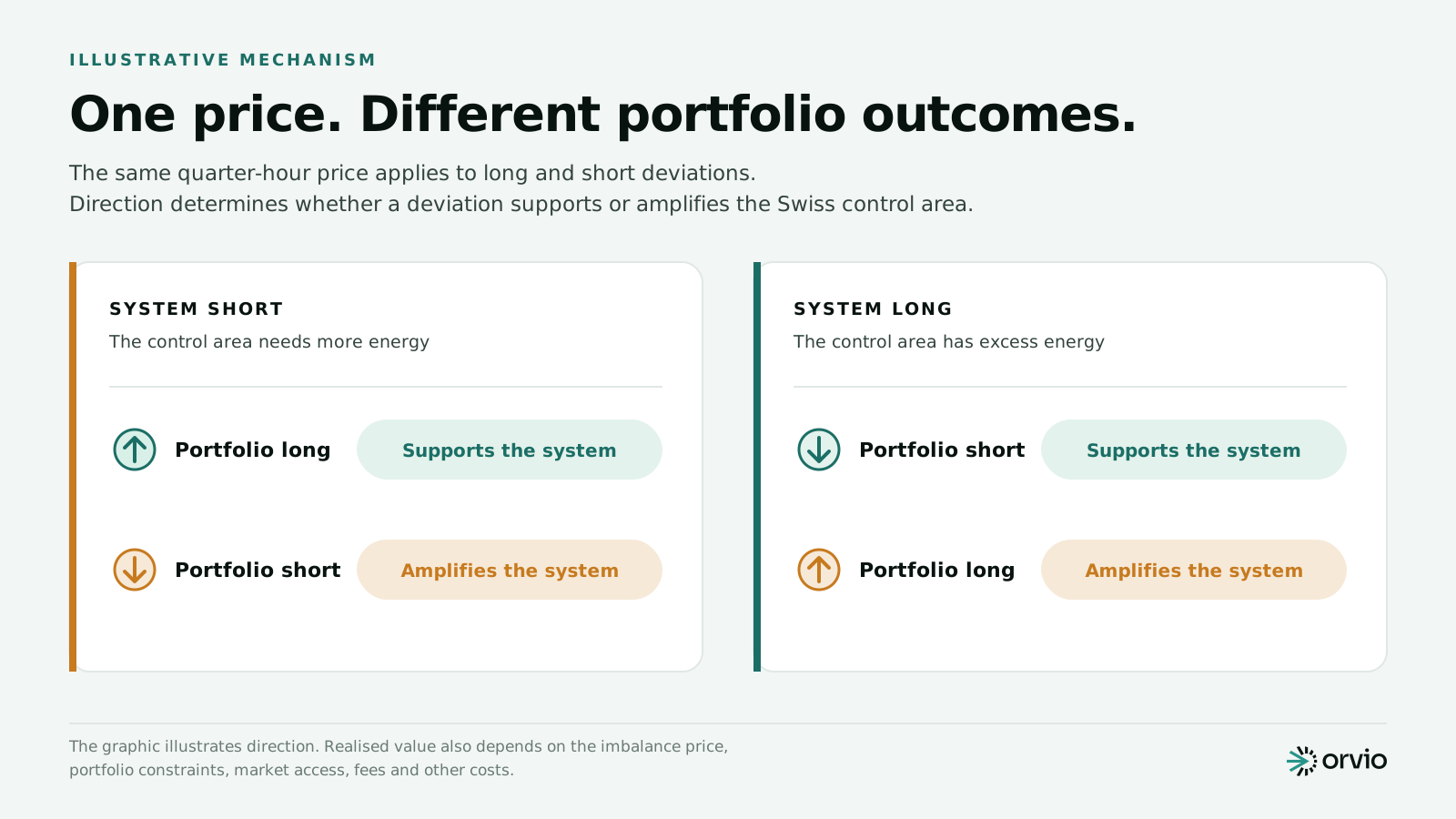
For a short control area, A is the higher of the separately calculated weighted-average prices for positive aFRR and positive mFRR; for a long control area, B is the lower of the corresponding negative-direction prices. Swissix day-ahead is considered when neither aFRR nor mFRR prices are available, or when there are exactly as many positive as negative activations. A linear scarcity component can also apply once the system imbalance exceeds Swissgrid’s defined reserve threshold.[3][4][8]
The payment direction is not fixed by ‘supportive’ or ‘amplifying’ alone. Appendix 1 explicitly notes that a negative imbalance price reverses the payment direction. This is why a system-supportive deviation can be economically useful without being automatically profitable.[3]
A quarter-hour example
Consider one illustrative 15-minute settlement period. Assume the Swiss control area is short and the imbalance price is +€180/MWh. Ignore fees, taxes, trading costs, asset costs and later settlement corrections. Under the simplified payment convention used here, a short balance group pays the positive price and a long balance group receives it.[3]
- Portfolio A is 2 MWh long. It supports the short system. At the assumed positive price, the illustrative settlement is a €360 credit: 2 MWh × €180/MWh.
- Portfolio B is 2 MWh short. It amplifies the short system. At the same assumed price, the illustrative settlement is a €360 charge: 2 MWh × €180/MWh.
The symmetry is the common price, not a guaranteed reward. If the applicable price were negative, the cash-flow direction would reverse. Real portfolio economics would also include the cost of creating or retaining the position, asset constraints, market transactions, fees and any correction between provisional and final settlement values.[3][7]
What the rule changes – and what it leaves in place
The rule makes the wider system direction commercially relevant to every imbalance position. Two portfolios with the same absolute deviation can have opposite system effects. A portfolio that can change its net position may therefore compare the expected settlement effect of acting, waiting or preserving flexibility for another market.
It does not remove the balance group’s responsibilities. The current rules retain forecasting and schedule-management duties, open-position limits, collateral requirements and Swissgrid’s ability to intervene when limits or system-security requirements are breached. Flexibility has commercial value only where the participant has the contractual right, market access and physical ability to use it.[3][6]
The opportunity is not imbalance by itself. It is a controlled position whose direction, price exposure and asset cost are understood before the quarter-hour closes.
Why better system and price forecasts matter
The final settlement information arrives after the operating decision. Swissgrid’s 2026–2030 Balancing Roadmap reports that publication of provisional imbalance prices and control-area imbalance was reduced to under 15 minutes in Q4 2025. These values remain indicative. Final quarter-hourly prices are published monthly by the 15th working day of the following month and can be corrected for three months after month-end. Published data therefore does not tell an operator in advance what the current quarter-hour will finally settle at.[4][5][7][8]
Decision support therefore needs a joined view: a probabilistic forecast of whether the Swiss control area will be short or long, a view of the likely imbalance price and a forecast of the portfolio’s own signed position. None is sufficient alone.
ElCom’s 2025 activity report places the mechanism in the same system context. It identifies weather-dependent generation as a continuing source of structural pressure and describes the single-price mechanism as a central measure intended to create stronger, symmetric incentives for system-supportive behaviour.[9]
The mechanism stopped being theoretical on 12 July. In the two hours after Switzerland’s overnight World Cup quarter-final, the national morning ramp arrived early, actual load ran up to 1.3 GW above the day-ahead forecast, and the control area went short. A portfolio that happened to be long in those quarter-hours was supporting the system, and under the single-price rule that direction, not just the size, determined which side of the settlement it stood on. We analysed that morning in detail in a companion article.
Practical implications by participant
- Utilities and balance-group managers can assess portfolio-position forecasts alongside system direction and price scenarios, while preserving their balancing, scheduling and risk controls.
- Aggregators can translate an expected system signal into a feasible portfolio response only after accounting for each asset’s availability, baseline, customer permission and market route.
- Battery operators can compare the expected settlement effect with state of charge, cycling degradation, efficiency losses and capacity already committed elsewhere.
- Hydro operators can compare the same signal with water value, reservoir and ramp constraints, plant commitments and alternative market revenue.
- Energy traders can use system-direction and price forecasts as inputs to short-term market and portfolio decisions, subject to mandate, limits and compliance.
What can go wrong, and who decides
None of this makes imbalance a free lunch. A forecast is a distribution, not a promise: an error in the system-direction call, the price view or the portfolio’s own position can each flip the result, negative prices reverse the payment direction, and asset availability, degradation, water value, fees and settlement revisions can outweigh the gross imbalance value. The mechanism rewards being right about direction, quarter-hour by quarter-hour, and it charges for being wrong.
That is why we build the forecasts and leave the decisions where they belong: with the trader, the dispatcher and the participant’s own risk limits. The single-price mechanism opens a clear route from system foresight to flexibility value. Walking it is a discipline, and it starts with knowing, before the quarter-hour closes, which way the system is leaning.
Sources and approach
This explainer was checked against Swissgrid’s launch announcement; Appendix 1, V3.1, effective 1 January 2026; the current Appendix 1, V3.2, effective 1 April 2026; Swissgrid’s 2026–2030 Balancing Roadmap; Swissgrid’s legal, imbalance-energy and control-energy/system-balance pages; and ElCom’s 2025 activity report. The sources were retrieved on 18 or 19 July 2026. The current operative mechanism was verified against the German V3.2 document, which Swissgrid identifies as legally binding; English translations are linked for readability. The publication-timing statement follows the later Balancing Roadmap, which reports the Q4 2025 reduction to under 15 minutes; Appendix 1 V3.2 retains the earlier approximate-30-minute wording.[1][2][3][4][5][6][7][8][9]
The worked example is illustrative, not an observed delivery interval. It assumes one 15-minute settlement period, a 2 MWh portfolio deviation, a short Swiss control area and a positive imbalance price of €180/MWh. Its simplified convention follows Appendix 1: at a positive short-control-area price, a short balance group pays and a long balance group receives. Fees, taxes, trading and asset costs, open-position requirements and settlement corrections are excluded.[3]
The mechanism diagram is an original Orvio explanation derived from the cited rules and system-balance definitions. It uses no production or customer data. Commercial implications are Orvio’s interpretation of the published mechanism and should not be read as legal, trading or investment advice.
Sources
- 1.New pricing mechanism for balancing energy from 2026 (opens in a new tab)
Swissgrid · News announcement published 28 March 2025; retrieved 18 July 2026 ·
- 2.Appendix 1: General Balance Group Regulations (opens in a new tab)
Swissgrid · V3.1, effective 1 January 2026; English translation; archived copy of the Swissgrid PDF captured 8 February 2026; retrieved 18 July 2026 ·
- 3.Appendix 1: General Balance Group Regulations (opens in a new tab)
Swissgrid · V3.2, effective 1 April 2026; English translation of the binding German document; retrieved 18 July 2026 ·
- 4.Anhang 1: Allgemeine Bilanzgruppenvorschriften (opens in a new tab)
Swissgrid · V3.2, legally binding German version, effective 1 April 2026; retrieved 18 July 2026 ·
- 5.Balancing Roadmap 2026–2030 (opens in a new tab)
Swissgrid · English edition, published 9 February 2026; retrieved 19 July 2026 ·
- 6.Sectoral contracts and annexes (opens in a new tab)
Swissgrid · Current web page; retrieved 18 July 2026 ·
- 7.Imbalance energy (opens in a new tab)
Swissgrid · Current web page and publication archive; retrieved 18 July 2026 ·
- 8.Control energy & system balance (opens in a new tab)
Swissgrid · Current definitions and indicative-data page; retrieved 18 July 2026 ·
- 9.ElCom 2025 activity report (German original) (opens in a new tab)
Swiss Federal Electricity Commission ElCom · 2025 activity report, published 27 May 2026; retrieved 18 July 2026 ·